
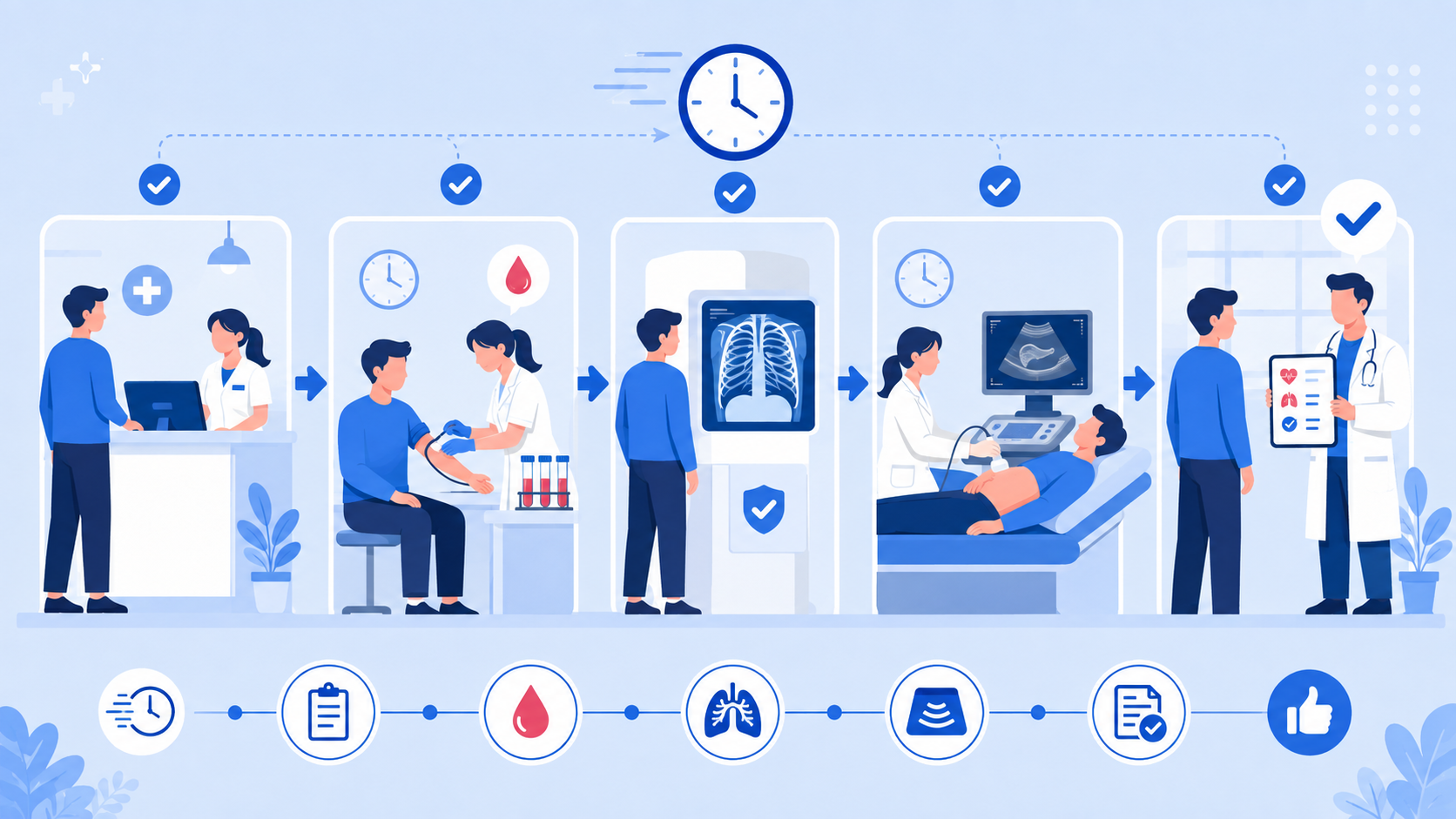
When you want to have a full-body checkup, how long does it take from scheduling, undergoing the examination, to receiving the report? In China, this time can be shortened to one day.
Yes, you read that correctly. At a Chinese hospital or health checkup center, you can choose a checkup package and complete a series of tests—including blood draw, urine test, electrocardiogram, ultrasound, X-ray, CT, MRI, and more—within 4 hours, and then receive a comprehensive report of dozens of pages. The entire process of a full-body checkup can be completed in one day.

This approach to health checkups is very common in China, but in many Western countries, a healthy adult without obvious symptoms rarely undergoes such a concentrated battery of tests on a regular basis.
So what are the differences between health checkups in China and those abroad, and what are the distinct advantages of Chinese health checkups?
1. Chinese health checkups are conducted in package form
Health checkups in China have developed into a very mature medical service market. Whether at public hospitals, private hospitals, or specialized checkup institutions, comprehensive health examinations are readily available.
Upon entering the checkup center of a Chinese hospital, you will typically see packages at different price points, such as basic checkup, male checkup, female checkup, middle-aged and elderly checkup, VIP checkup, etc. The higher the price, the more examination items are usually included.
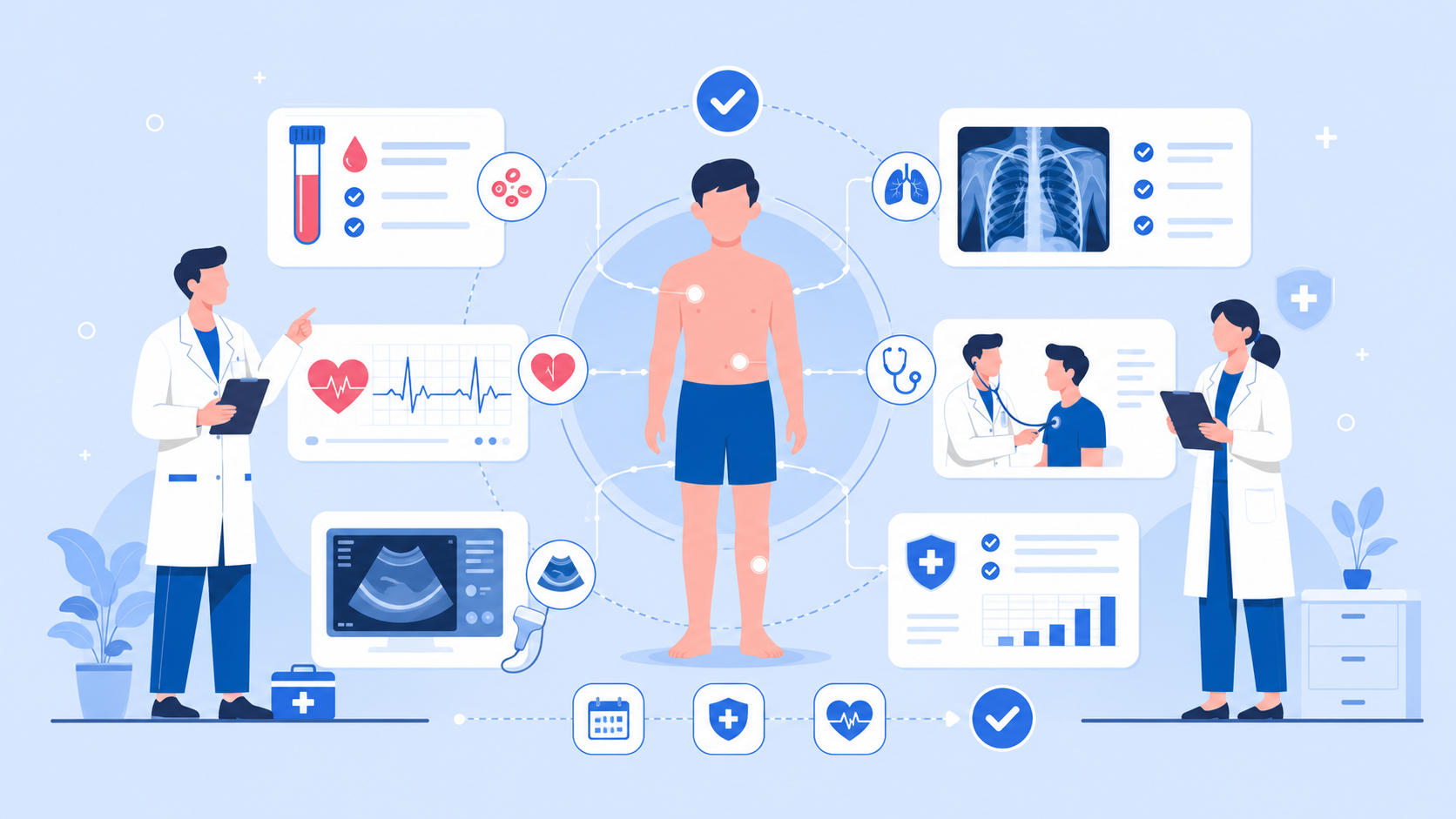
A common adult checkup package includes:
- Height, weight, blood pressure, and BMI
- Complete blood count and urinalysis
- Liver function and kidney function
- Blood glucose and blood lipids
- Electrocardiogram
- Ultrasound examination
- Chest X-ray
- Internal medicine and surgical examinations
Higher-priced packages may include additional tests such as CT, gastroscopy, colonoscopy, breast examination, gynecological examination, prostate examination, various tumor marker tests, genetic testing, and more.
2. Abroad, checkups are often arranged based on age and risk
In many countries, preventive medical examinations are typically arranged according to age, gender, family history, past medical history, lifestyle habits, and other risk factors.
For example, a 30-year-old adult with no underlying diseases and no significant family history would receive very different screening items compared to a 55-year-old with a history of smoking, hypertension, and a family history of colorectal cancer.
The screening recommendations of the U.S. Preventive Services Task Force are developed based on different ages and risks. For instance, diabetes screening considers age and risk factors such as overweight or obesity, and other diseases have their own applicable populations and screening criteria.
Medical organizations in Canada also do not encourage healthy adults without significant risk factors to undergo a complete annual physical examination, and they do not recommend routine annual blood tests for individuals without clinical indications.
Therefore, a seemingly healthy foreigner may not have undergone a "full-body checkup" like those in China for many years.
3. Chinese health checkups include many examination items
By purchasing a checkup package in China for $50 or $300, you can complete a dozen or even dozens of medical tests at once. Ultrasound examinations are also very common, and ultrasounds of the abdomen, thyroid, breast, and other areas are often included in these packages.
In routine preventive care in Western countries, doctors often determine whether a particular test is appropriate before deciding to perform it.
Behind the Western approach lies a potential consideration: any test may yield abnormal results, but abnormal results do not necessarily mean disease.
Suppose 1,000 completely asymptomatic individuals undergo a test. Even if the vast majority do not have the disease, some may show abnormal imaging, slightly elevated indicators, or other incidental findings. This may lead to further testing, additional imaging, biopsy, or even surgery, only to find that these abnormalities do not affect health.
However, there is a very significant difference that leads to the medical disparities between China and other countries: the sheer number of medical institutions and healthcare professionals in China.
China does not impose quotas on medical professions such as doctors and nurses, and there are numerous medical schools, so there is no shortage of healthcare workers as in many other countries.
This results in intense competition among Chinese medical institutions. Checkup and examination centers can even operate 24 hours a day, allowing for large-scale tests such as MRI and CT at any time, and at very low prices.

4. Chinese people are accustomed to annual checkups
Annual health checkups provided by employers are one of the most common benefits in Chinese companies, so many Chinese people have developed the habit of having a checkup once a year.
Whether at a checkup center or the checkup department of a hospital, you can book a package, arrive at the hospital on an empty stomach in the morning, and then follow the checkup process sheet to complete examinations in different departments one by one, and finally wait for the report. This process is generally completed within 4 hours.
Unlike China's annual checkup approach, preventive care in other countries is often dispersed throughout long-term medical care. For example, a person may have blood pressure and cholesterol checked this year, start colorectal cancer screening a few years later, and undergo breast cancer, cervical cancer, or other screenings after meeting age or risk criteria.
The difference is that in China, ordinary people can choose a full-body checkup at any time, and they can also participate in various disease screenings, especially cancer screenings, provided by national health authorities. These two are not contradictory; ordinary people can choose freely according to their own preferences.
5. Chinese health checkup reports are very detailed
After completing a full-body checkup in China, you can receive your complete report in as little as half a day or up to 2–4 days.
The report will list each test result, reference ranges, and any findings and recommendations, such as elevated blood lipids, thyroid nodules, fatty liver, liver cysts, pulmonary nodules, elevated uric acid, and suggestions for re-examination after 6 months, etc.
For foreigners, after a Chinese checkup, suddenly discovering five or six issues can be quite alarming.
In reality, many of these findings may only require observation or regular follow-up and do not necessarily require treatment. However, they are still signals that threaten health and should prompt lifestyle adjustments based on the doctor's advice, such as quitting smoking and limiting alcohol.
Additionally, if you undergo a checkup at a large Chinese hospital and abnormal results are found, the checkup center can directly arrange an appointment with the corresponding specialist at the hospital for further in-depth specialist examinations and health management. This greatly saves time and improves the efficiency of seeing a specialist.
6. Chinese health checkups can be purchased directly
Another major feature of Chinese health checkups is that any individual can purchase them directly.
You do not need a doctor's referral or to prove that you have a certain disease risk. You can directly choose a hospital or checkup institution, purchase a package, and then schedule an appointment.
If you wish to add certain tests, most institutions allow you to add items on-site.
This model is very convenient for foreigners, especially for those who wish to complete a large number of tests in a short period. Chinese health checkups are highly efficient and allow you to complete examinations within any half-day to one day.
7. More tests do not necessarily mean higher quality checkups
Chinese checkup institutions offer a wide variety of packages, ranging from tens of dollars to hundreds or even thousands of dollars. Higher-priced packages often differentiate themselves by adding more examination items.
If you add a large number of tests unrelated to your age and risk simply because a package is more expensive, the medical value may not be as great as imagined.
When choosing a Chinese checkup package, you can first consider your age, gender, family medical history, smoking and drinking habits, and past diseases, and then decide whether to add gastroscopy, colonoscopy, CT, MRI, cardiovascular examinations, or specific cancer screenings.
8. Advantages of Chinese health checkups for foreigners
If you live in a country where seeing a specialist and arranging tests involves long waiting times, Chinese health checkups may offer you a completely different experience.
You can complete a large number of tests in one day, including ultrasound, electrocardiogram, blood draw, X-ray, MRI, CT, PET-CT, various endoscopic examinations, and some further specialist imaging tests can also be completed in a very short time.
Large Chinese hospitals have a huge patient volume and examination capacity, making them very convenient for systematic health examinations.
For foreigners, undergoing a checkup in China allows you to take full advantage of the convenience, rich selection of tests, speed, and low cost of Chinese medical examinations, while selecting examination items according to your age and health risks. After abnormalities are found, the corresponding specialist can determine whether further examination or treatment is needed.