
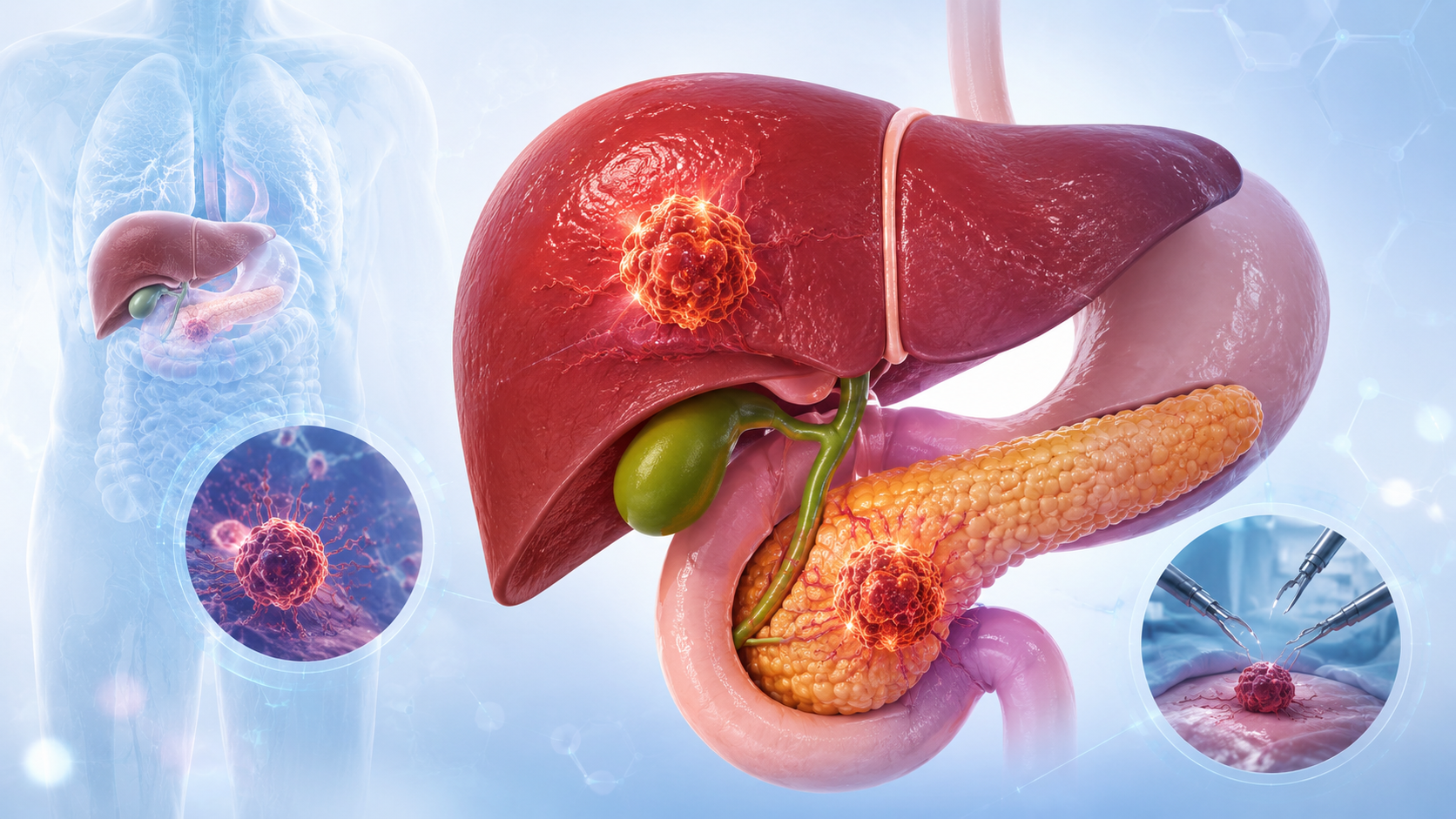
Complex Hepatobiliary and Pancreatic Tumors
Hepatobiliary and pancreatic malignancies include liver cancer, cholangiocarcinoma, gallbladder cancer, and pancreatic cancer, all of which are generally difficult to treat. Whether surgical resection is feasible often directly influences the treatment strategy; however, in complex cases, the decision depends not only on “tumor size” but also on vascular invasion, bile duct or peripancreatic tissue involvement, as well as the patient’s liver function, nutritional status, and overall tolerance.
For patients considering treatment, China’s strengths in complex hepatobiliary and pancreatic surgery are particularly notable: high case volumes, concentrated specialty experience, mature multidisciplinary treatment, rapidly advancing complex resection and reconstruction techniques, and a rich array of conversion therapies, minimally invasive approaches, and perioperative locoregional treatments.
High Treatment Difficulty of Hepatobiliary and Pancreatic Malignancies
Hepatobiliary and pancreatic malignancies mainly fall into three categories: liver malignancies, such as hepatocellular carcinoma and intrahepatic cholangiocarcinoma; biliary tract malignancies, such as cholangiocarcinoma and gallbladder cancer; and pancreatic malignancies, most commonly pancreatic ductal adenocarcinoma.
The reasons for their refractory nature include: the liver’s rich blood supply, with many patients having concurrent hepatitis B, cirrhosis, or insufficient hepatic functional reserve; cholangiocarcinoma often located near the hepatic hilum, surrounded by critical structures like the portal vein, hepatic artery, and bile ducts; and pancreatic cancer situated deep, frequently adjacent to major vessels such as the superior mesenteric vessels, portal vein, and celiac trunk. Surgery must aim for complete tumor clearance while preserving residual liver, biliary, pancreatic, and gastrointestinal function, making it significantly more challenging than routine abdominal procedures.
In terms of disease burden, China has a large number of liver cancer patients. For example, in 2022, there were approximately 368,000 new cases of liver cancer, 119,000 new cases of pancreatic cancer, and 31,000 new cases of gallbladder cancer in China. This has led major Chinese hepatobiliary and pancreatic centers to manage a high volume of complex cases over time, accumulating substantial surgical and comprehensive treatment experience.
Treatment Modalities for Hepatobiliary and Pancreatic Malignancies
If the tumor is still resectable, surgery is typically the core treatment.
For liver cancer, options include hepatectomy, ablation, liver transplantation, interventional therapy, and systemic therapy; for cholangiocarcinoma and gallbladder cancer, hepatectomy, bile duct resection, lymph node dissection, and in some cases vascular reconstruction are often required; for pancreatic cancer, pancreatoduodenectomy, distal pancreatectomy, or total pancreatectomy may be necessary, with some borderline resectable cases needing neoadjuvant or conversion therapy first.
If surgery is initially not feasible, it does not mean there is no chance. Some patients can achieve tumor control through interventional therapy, radiotherapy, chemotherapy, immunotherapy, targeted therapy, etc., and then be reassessed for resectability once the tumor shrinks or vascular invasion decreases.
For cases with peritoneal metastasis, malignant ascites, or high risk of peritoneal recurrence, some centers may also consider intraperitoneal chemotherapy or hyperthermic intraperitoneal chemotherapy (HIPEC).
Advantages of Treating Hepatobiliary and Pancreatic Tumors in China
1. High Case Volumes and Extensive Clinical Experience
Treatment of hepatobiliary and pancreatic tumors heavily relies on clinical experience. The more cases a center handles over time, the more likely it is to develop mature systems for preoperative assessment, surgical approaches, complication management, and postoperative follow-up. China accounts for a high proportion of global liver cancer cases, and its hepatobiliary and pancreatic specialties have long dealt with complex scenarios such as hepatitis B-related liver cancer, liver cancer with cirrhosis, huge liver tumors, hilar cholangiocarcinoma, and pancreatic cancer with vascular invasion.
2. Emphasis on Staging, Liver Function, and Multidisciplinary Decision-Making in Liver Cancer Treatment
China’s liver cancer diagnosis and treatment pathways emphasize multidisciplinary involvement, with treatment modalities including hepatectomy, liver transplantation, ablation, interventional therapy, radiotherapy, and systemic antitumor therapy, all underscored by MDT collaboration.
For complex liver cancer patients, preoperative evaluation typically focuses on liver function, coagulation, bilirubin, portal hypertension, and future liver remnant volume. Before hepatectomy, future liver remnant volume must be assessed; for patients with chronic liver disease, parenchymal damage, or cirrhosis, a higher proportion of residual liver volume usually needs to be preserved. Such assessments directly relate to the risk of postoperative liver failure.
3. Maturing Capabilities in Complex Hepatectomy and Vascular/Biliary Reconstruction
Common challenges in complex hepatobiliary tumors include: tumors near the first, second, or third hepatic hilum; invasion of the portal vein, hepatic veins, or inferior vena cava; proximity to the biliary confluence; and huge tumors with insufficient future liver remnant. High-level hepatobiliary surgery centers in China generally possess a relatively complete technical system for complex hepatectomy, such as extended hemihepatectomy, central hepatectomy, caudate lobectomy, radical hilar cholangiocarcinoma resection, portal vein or hepatic artery reconstruction, and bilioenteric anastomosis.
The value of these techniques lies in the possibility that some cases previously deemed unresectable may, after meticulous imaging assessment, 3D reconstruction, preoperative biliary drainage, portal vein embolization, or staged treatment, gain a chance for surgical reassessment. However, such procedures carry higher risks and must be performed in experienced specialty centers.
4. Pancreatic Cancer Surgery Prioritizes Specialty Centers and Neoadjuvant Therapy
The difficulty of pancreatic cancer surgery lies in the tumor’s proximity to major vessels and the potential for complications after pancreatoduodenectomy, such as pancreatic fistula, bleeding, infection, and delayed gastric emptying. Minimally invasive radical pancreatic cancer surgery in China has shown comparable results to open surgery in terms of safety, lymph node yield, and R0 resection rate.
For borderline resectable pancreatic cancer, neoadjuvant therapy can be chosen after multidisciplinary discussion, with surgery performed after downstaging; if combined venous resection after neoadjuvant therapy achieves R0 resection, some patients may obtain survival benefits similar to those with initially resectable disease. This is crucial for pancreatic cancer patients, as rushing to surgery may not be more appropriate than controlling the tumor first.
5. Gradual Integration of Minimally Invasive, Robotic, 3D Reconstruction, and Fluorescence Navigation in Complex Surgeries
In Chinese hepatobiliary surgery, techniques such as laparoscopy, robotics, 3D visualization, intraoperative ultrasound, and ICG fluorescence navigation have gradually entered the hepatobiliary and pancreatic surgical arena. They help surgeons better visualize tumors, vessels, bile ducts, and resection margins.
ICG fluorescence imaging can be used to display liver tumors, biliary anatomy, and hepatic segment boundaries, contributing to improved safety and quality in open, laparoscopic, and robotic hepatectomy.
For patients, minimally invasive or robotic surgery may offer advantages like smaller incisions, faster recovery, and less bleeding, provided the tumor location, extent of invasion, surgeon experience, and hospital conditions are suitable. For complex hilar cholangiocarcinoma, severe vascular invasion, huge tumors, or dense adhesions from previous surgeries, open surgery may still be safer.
6. Conversion Therapy Offers New Surgical Opportunities for Liver Cancer
A prominent feature of liver cancer treatment in China is the extensive experience in comprehensive management of intermediate-advanced disease. For patients with insufficient future liver remnant, portal vein embolization or ALPPS can promote hypertrophy of the future liver remnant; for those with high tumor burden, portal vein tumor thrombus, or initially unsuitable for surgery, combinations of TACE, HAIC, radiotherapy, targeted therapy, and immunotherapy can be considered to control the tumor before reassessment.
However, conversion therapy is not universally successful and may be associated with tumor progression, adverse drug reactions, or deterioration of liver function. Patients require regular imaging, tumor marker, and liver function monitoring.
7. Prevention of Peritoneal Metastasis and Recurrence
Once hepatobiliary and pancreatic malignancies develop peritoneal metastasis or malignant ascites, treatment becomes markedly more difficult. Intraperitoneal chemotherapy is a regional treatment where drugs are delivered directly into the peritoneal cavity, aiming for more thorough contact with free cancer cells, microscopic foci, or peritoneal lesions. HIPEC additionally combines thermal effects and perfusion lavage.
Intraperitoneal chemotherapy may be considered for hepatobiliary and pancreatic cancer patients with peritoneal metastasis, malignant ascites, or high-risk factors for peritoneal carcinomatosis; however, it is clearly stated that significant hepatic or renal dysfunction, severe bone marrow suppression, serious infection, complete intestinal obstruction, or unstable vital signs warrant caution or contraindication.
8. Accessibility and Overall Cost Advantages of Treatment in China
For overseas patients, especially those facing long waiting times, high treatment costs, or seeking a second opinion, Chinese hepatobiliary and pancreatic surgery is highly attractive.
Key advantages include: relatively centralized diagnostic workup, a larger number of hepatobiliary and pancreatic specialists, faster complex case discussions, tight integration of imaging, intervention, endoscopy, surgery, and systemic therapy, and more controllable overall treatment costs in many cases.
Risks and Limitations
Complex hepatobiliary and pancreatic surgery carries high risks, including bleeding, bile leak, pancreatic fistula, abdominal infection, liver failure, delayed gastric emptying, malnutrition, thrombosis, and tumor recurrence. Risks are further increased in patients with cirrhosis, jaundice, hypoalbuminemia, severe cachexia, diabetes, or poor cardiopulmonary function.
Methods such as HIPEC, conversion therapy, combined vascular resection, and robotic surgery also have specific indications, particularly in hepatobiliary and pancreatic tumors with peritoneal metastasis.
How Patients Can Choose Hepatobiliary and Pancreatic Tumor Treatment in China
When selecting a hospital, focus on four aspects: whether there is a mature hepatobiliary and pancreatic specialty team; whether MDT evaluation is available; whether complex complications can be managed; and whether a long-term follow-up plan is provided.
Before consultation, it is advisable to prepare contrast-enhanced CT or MRI, pathology reports, tumor markers, liver and kidney function tests, coagulation profile, hepatitis B-related markers, and previous treatment records.
Frequently Asked Questions (FAQ)
Q1: Should surgery be performed immediately if it is feasible?
Not necessarily. Some patients are suitable for prompt surgery, while others need to first manage jaundice, infection, malnutrition, or undergo neoadjuvant therapy. The decision depends on tumor extent, vascular invasion, liver function, performance status, and physician assessment.
Q2: What are the advantages of treating hepatobiliary and pancreatic tumors in China?
The main advantages are very high case volumes, multidisciplinary collaboration, experience in complex resection and reconstruction, a rich array of conversion therapies, and extensive expertise in minimally invasive, robotic, 3D reconstruction, fluorescence navigation, and perioperative management at some large hepatobiliary surgery centers.
Q3: Is robotic surgery always better than open surgery?
No. Robotic or laparoscopic surgery is suitable for selected cases, with potential advantages of less trauma and faster recovery. However, for cases with significant vascular invasion, huge tumors, complex anatomy, or high safety risks, open surgery may be more appropriate.
Q4: If the tumor is initially unresectable, is there still a chance to become resectable?
Some patients do have a chance. In liver cancer, conversion can be attempted through interventional therapy, HAIC, targeted therapy, immunotherapy, radiotherapy, portal vein embolization, etc.; borderline resectable pancreatic cancer patients may also undergo neoadjuvant therapy first. Success depends on tumor biology and the patient’s tolerance.
Q5: Is HIPEC suitable for all hepatobiliary and pancreatic tumor patients?
No. It is mainly considered for specific patients with peritoneal metastasis, malignant ascites, or high risk of peritoneal recurrence. Caution or avoidance is needed in cases of poor liver/kidney function, severe infection, intestinal obstruction, or unstable vital signs.